

Air travelers across the United States are being urged to arrive earlier than minimum guidelines as airport congestion and TSA screening delays continue to fluctuate, especially for first-time flyers and families.
- TSA Arrival Guidelines vs Reality at US Airports
- Why More Travelers Are Missing Flights
- Best Airport Arrival Times by Flight Type
- TSA Security Wait Times Remain Highly Variable
- Families Urged to Add Extra Time
- Does TSA PreCheck Reduce Arrival Time?
- When Travelers Should Arrive Even Earlier Than Recommended
- Key Takeaway for US Travelers
- Travel Planning Tip
While the general rule of thumb remains two hours for domestic flights and three hours for international departures, travel experts warn that these benchmarks often fall short during peak travel periods, early-morning departures, and holiday weekends.
TSA Arrival Guidelines vs Reality at US Airports
The Transportation Security Administration officially recommends arriving at airports at least two hours before domestic flights and three hours before international flights. However, real-world conditions at major US airports frequently require additional buffer time.
Security wait times can vary significantly based on:
- Time of day
- Airport size and staffing levels
- Passenger volume
- Weather disruptions
Early-morning flights—especially between 5 a.m. and 8 a.m.—often experience some of the longest TSA lines due to compressed departure schedules and limited checkpoint staffing.
Why More Travelers Are Missing Flights
According to travel planners and airport operations data, missed flights are increasingly linked to underestimating security screening time, not traffic or late arrivals at the airport entrance.
Common reasons travelers arrive too late include:
- Assuming TSA lines move consistently
- Confusing airline check-in deadlines with boarding time
- Not accounting for baggage drop cut-offs
- Traveling with children without extra buffer time
Airlines typically close boarding gates 15–30 minutes before departure, regardless of TSA delays.
Best Airport Arrival Times by Flight Type
Domestic Flights
Travel experts now recommend:
- 2.5 to 3 hours early during peak travel periods
- 2 hours early only during off-peak weekday travel
International Flights
International departures often involve additional document checks and earlier counter closures.
Recommended arrival:
➡️ 3 to 3.5 hours before departure
Families and first-time international travelers are advised to arrive even earlier to allow time for passport and boarding verification.
TSA Security Wait Times Remain Highly Variable
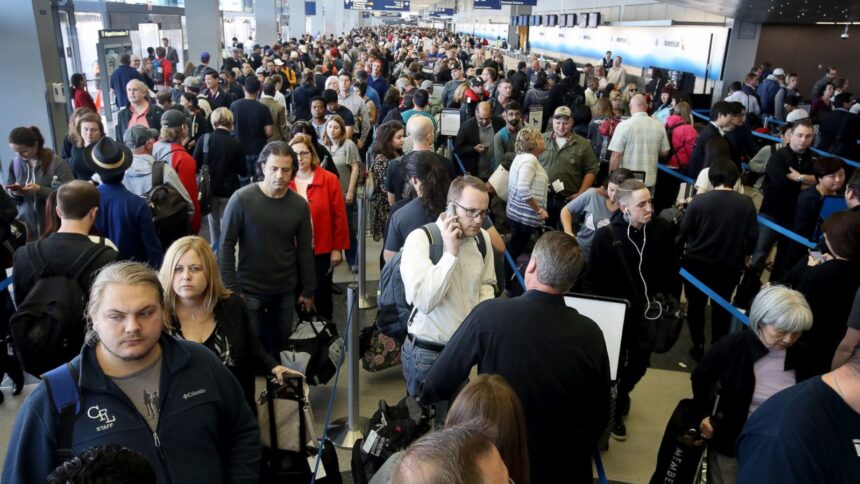
Security screening remains one of the least predictable parts of the airport experience. Typical wait times currently range from:
- 10–20 minutes during low traffic
- 30–45 minutes during average conditions
- 60–90+ minutes during holidays, weekends, and weather disruptions
Travelers seeking airport-specific data can review detailed TSA wait time patterns here:
https://www.airportguideusa.com/tsa-wait-times-at-us-airports-how-long-security-really-takes/
Families Urged to Add Extra Time
Families traveling with children face additional screening requirements, including stroller checks, carry-on inspections, and longer checkpoint processing.
Travel advisors recommend families:
- Add 30–45 minutes beyond standard arrival guidelines
- Prepare children in advance for security procedures
- Minimize carry-on complexity
First-time flyers are also encouraged to arrive early to avoid confusion navigating large terminals and security checkpoints.
Does TSA PreCheck Reduce Arrival Time?
Programs such as TSA PreCheck can reduce time spent at security checkpoints, but experts caution against relying on them as a substitute for early arrival.
While TSA PreCheck lanes are typically faster, they can still experience congestion during peak travel windows. Most travelers save 15–30 minutes, not hours.
When Travelers Should Arrive Even Earlier Than Recommended
Additional buffer time is strongly advised when:
- Flying on major holidays
- Departing early in the morning
- Checking bags
- Traveling during school vacation periods
- Flying from large hub airports
In these cases, arriving early is considered risk management, not inconvenience.
Key Takeaway for US Travelers
Airport arrival timing in the United States is no longer a one-size-fits-all rule. TSA congestion, airline policies, and passenger volume make early arrival the safest option—especially for families and infrequent travelers.
Arriving early may mean extra waiting, but arriving late can mean missed flights, rebooking fees, and disrupted travel plans.
Travel Planning Tip
Planning a flight soon?
Explore arrival-time guides, TSA wait-time insights, and airport-specific planning tools on AirportGuideUSA.com to arrive prepared and travel with confidence.