


Every traveler has stood in a slow security line watching people glide through a separate lane and wondered: should I be paying for that? TSA PreCheck, Global Entry, and CLEAR all promise to speed up your airport experience — but they work in completely different ways, they are not interchangeable, and choosing the wrong one for your travel habits is a waste of money. This guide breaks down exactly what each program does, what it costs in 2026, and which combination makes sense for your situation.
- Table of Contents
- What Each Program Actually Does
- Program Costs at a Glance
- TSA PreCheck: The Baseline Option
- Global Entry: The Upgrade for International Travelers
- CLEAR: The Biometric Fast Lane
- TSA PreCheck vs Global Entry: Which Is Better?
- Do You Need Both CLEAR and PreCheck?
- How to Pay Less for All Three
- Which Program Is Right for You
- FAQ
- Key Takeaways
Quick Answer (TL;DR)
If you fly domestically only, get TSA PreCheck ($78 to $85 for five years). If you travel internationally even once in five years, get Global Entry ($120 for five years) — it includes TSA PreCheck automatically. CLEAR ($209 per year) is a private, add-on service that speeds up ID verification at security but does not replace PreCheck or Global Entry. The best setup for frequent travelers at busy airports is Global Entry plus CLEAR. Many premium travel credit cards cover the cost of all three.
Table of Contents
- What Each Program Actually Does
- Program Costs at a Glance
- TSA PreCheck: The Baseline Option
- Global Entry: The Upgrade for International Travelers
- CLEAR: The Biometric Fast Lane
- TSA PreCheck vs Global Entry: Which Is Better?
- Do You Need Both CLEAR and PreCheck?
- How to Pay Less for All Three
- Which Program Is Right for You
- FAQ
- Key Takeaways
What Each Program Actually Does
These three programs solve three different problems. Confusing them is the most common mistake travelers make.
TSA PreCheck is a federal program run by the Transportation Security Administration. It lets approved, low-risk travelers use a dedicated screening lane where you keep your shoes, belt, and light jacket on, leave your laptop and TSA-approved liquids in your bag, and skip the body scanner in most cases. It speeds up the physical security screening process at more than 200 participating US airports.
Global Entry is run by US Customs and Border Protection (CBP). It gives you access to dedicated kiosks at airports when you return from international travel, letting you skip the standard customs and immigration line entirely. It also automatically includes TSA PreCheck for all domestic security screenings, making it a two-in-one program.
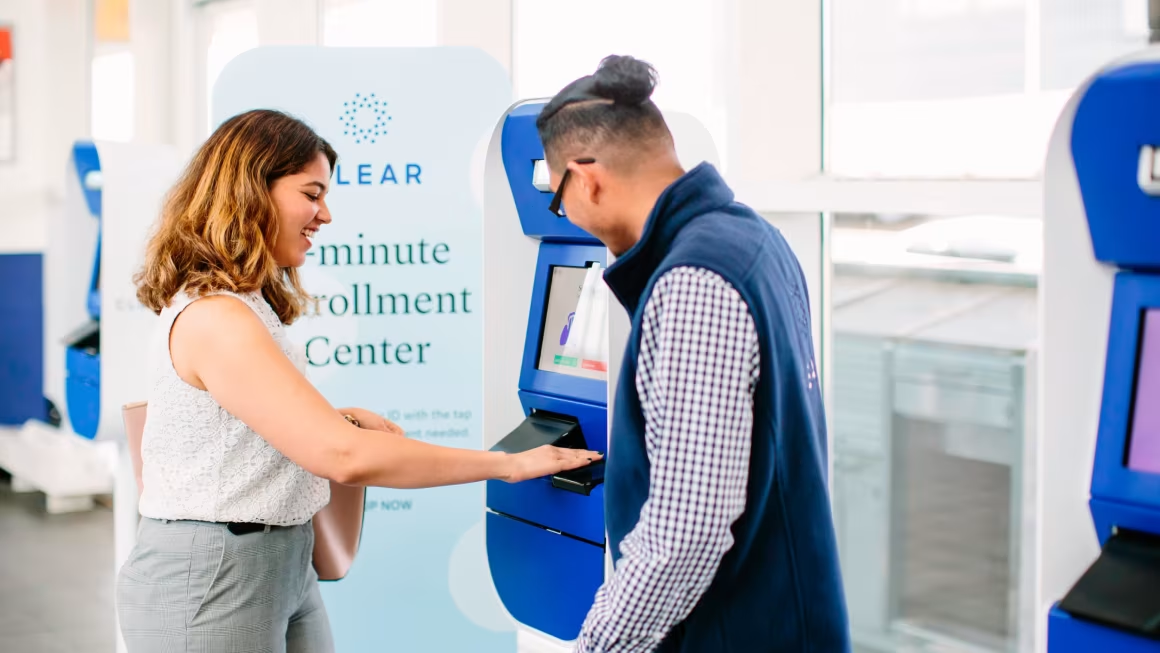
CLEAR is a private, subscription-based service — not a government program. CLEAR uses biometrics (your eyes or fingerprints) to verify your identity at a dedicated kiosk in the terminal, then a CLEAR ambassador walks you directly to the physical screening area, bypassing the document-check line. Critically, CLEAR does not change what happens at the X-ray machine. You still go through the same screening as everyone else. CLEAR just removes the ID verification wait.
Understanding this distinction is the key to making the right choice.
Program Costs at a Glance
| Program | New Enrollment | Renewal | Term | Includes |
|---|---|---|---|---|
| TSA PreCheck (IDEMIA) | $76.75 | ~$70 | 5 years | PreCheck screening lane |
| TSA PreCheck (Telos) | ~$78 | ~$70 | 5 years | PreCheck screening lane |
| TSA PreCheck (CLEAR) | $79.95 (refunded with CLEAR+ signup) | ~$70 | 5 years | PreCheck screening lane |
| Global Entry | $120 | $120 | 5 years | PreCheck + expedited customs |
| CLEAR Plus | $209/year | $209/year | 1 year | Identity verification fast lane |
Fees verified as of June 2026. All fees are nonrefundable application fees, not membership guarantees.
Expert Tip: If you fly internationally at all, the math on Global Entry is almost impossible to argue against. You pay $35 to $43 more than a standalone TSA PreCheck membership and you get PreCheck bundled in. Over five years, that extra cost works out to roughly $7 to $9 per year for expedited international customs clearance.
TSA PreCheck: The Baseline Option
TSA PreCheck is the entry point for most travelers. If you fly only within the US and have no international travel on the horizon, it is the right starting point.
How It Works
You apply online, complete an in-person enrollment appointment where you submit fingerprints and documents, and — if approved — receive a Known Traveler Number (KTN). You add that KTN to every flight booking, and a TSA PreCheck indicator appears on your boarding pass. At the airport, you use the designated PreCheck lane.
About 99 percent of TSA PreCheck members wait less than 10 minutes at airport checkpoints nationwide. That is the headline benefit: consistent, predictable speed through security.
Enrollment Providers in 2026
The current TSA PreCheck enrollment providers are CLEAR, IDEMIA, and Telos. The fees vary slightly between providers:
- IDEMIA has the most locations nationwide and charges $76.75 for new enrollment.
- Telos operates 396 centers in 38 states as of mid-2026, with fees around $78.
- CLEAR offers TSA PreCheck enrollment with a refund of $79.95 when you also complete a CLEAR Plus application.
Most applicants receive their KTN within three to five business days after their in-person appointment.
Who Should Get TSA PreCheck
TSA PreCheck makes sense if you fly domestically two or more times per year, do not hold a US passport or have no international travel planned, or want the lowest upfront cost for expedited screening.
Children 12 and under can use the PreCheck lane with an enrolled parent at no charge. Teens aged 13 to 17 can use the lane when traveling on the same reservation as an enrolled parent and when their boarding pass also shows the PreCheck indicator.
Expert Tip: Always add your KTN when booking flights — not afterward. Many airlines will not add it retroactively to an existing reservation, which means you will lose PreCheck benefits on that trip even if you are enrolled.
Global Entry: The Upgrade for International Travelers
Global Entry is the smarter choice for the majority of travelers who fly internationally even occasionally. It costs $120 for five years and bundles TSA PreCheck at no extra charge.
What You Get
Global Entry is a US Customs and Border Protection program that allows expedited clearance for pre-approved, low-risk travelers upon arrival in the US after traveling internationally. At participating airports, you skip the customs and immigration line and use a dedicated self-service kiosk instead. The kiosk scans your passport, takes your photo, and issues a receipt that you hand to a CBP officer. The whole process typically takes under five minutes.
Global Entry also offers preclearance benefits: passengers returning from certain countries including Canada, Mexico, and the Bahamas can arrive in the US as domestic passengers, bypassing the customs line entirely.
Beyond the US, Global Entry membership gives you reciprocal access to expedited entry programs in several other countries, including Canada’s NEXUS lanes and similar programs in the Netherlands, South Korea, and the United Kingdom (subject to current bilateral agreements — verify at cbp.gov before travel).
The Application Process
- Create a Trusted Traveler Programs (TTP) account at ttp.dhs.gov
- Submit your application and pay the nonrefundable $120 fee
- Wait for conditional approval from CBP
- Schedule and attend an in-person interview at a Global Entry enrollment center
Most applicants receive conditional approval within three to four weeks, though processing can stretch to eight or more weeks during busy periods.
The interview itself is straightforward — typically under 15 minutes. A CBP officer reviews your documents, asks a few questions about your travel history, and takes your fingerprints. Most applicants receive approval within three to five days after their in-person appointment.
The Interview Wait Time Problem
Here is the biggest friction point with Global Entry in 2026. Interview wait times at major centers now run four to 11 months depending on your location, with smaller regional centers and border towns typically running four to eight weeks.
Three ways to shorten this wait:
- Enrollment on Arrival (EOA): If you have a conditionally approved application and you are returning from an international flight, you can complete your interview on the spot at select US airports without a prior appointment.
- Cancellation monitoring: Appointment slots open up constantly due to cancellations. Check your TTP account frequently or use a third-party alert service.
- Less popular centers: Wait times vary dramatically by location. A center at a smaller regional airport may have appointments available within weeks while a major hub like JFK or LAX books out months in advance.
You have 730 days from conditional approval to complete your interview before the application is canceled. There is no need to panic about wait times if you start early.
Global Entry Renewal
The renewal fee is $120, and most members in 2026 still require an in-person interview — CBP issues conditional approval and you schedule the interview the same way a new applicant would. A minority of renewing members with clean records and extensive recent travel may be auto-approved without an interview, but you will not know which path applies to you until CBP processes your application.
Start your renewal up to 12 months before your expiration date. If your membership expires before your renewal is fully processed, you lose both Global Entry and TSA PreCheck benefits immediately — there is no grace period.
Expert Tip: When renewing, apply early and book the first interview slot offered, even if it is inconvenient. You can always monitor for a cancellation closer to your preferred date while keeping the backup appointment locked in.
CLEAR: The Biometric Fast Lane
CLEAR is a fundamentally different product from the government programs above. It is a private, for-profit service that uses biometric data to speed up one specific step in the security process: identity verification.
How CLEAR Works
At airports with CLEAR lanes, you scan your iris or fingerprint at a CLEAR kiosk. A CLEAR ambassador then escorts you past the document-check line directly to the security screening equipment. If you also have TSA PreCheck, the ambassador takes you to the front of the PreCheck lane. If you have standard screening only, you go to the front of the regular screening lane.
CLEAR is available at about 60 US airports. If your home airport is not among them, the membership has no value for your regular travel.
What CLEAR Does Not Do
This is critical: CLEAR does not change your experience at the X-ray machine or body scanner. You still remove your laptop and liquids for standard screening, or you benefit from the PreCheck process if enrolled. CLEAR only eliminates the ID and boarding pass check line. At airports with short document lines or when PreCheck lanes are already fast, CLEAR adds little value on top of PreCheck alone.
CLEAR Pricing in 2026
CLEAR Plus costs $209 per year for an individual membership. You can add up to three additional adults at $125 per person per year. Children under 18 join the CLEAR lane for free.
Delta Air Lines is restructuring its CLEAR partnership as of June 2026. Diamond Medallion members who previously received complimentary CLEAR will instead pay $129 per year, while Platinum, Gold, and Silver Medallion members and Delta SkyMiles Amex cardholders pay $169 per year — a $40 discount off the standard $209 price.
United MileagePlus members have access to discounted rates through their own CLEAR partnership, with rates varying by elite status tier.
TSA PreCheck vs Global Entry: Which Is Better?
For most travelers, this is the actual decision to make. Here is the direct answer:
Get Global Entry if you have a US passport and have taken, or plan to take, even one international trip in the next five years.
The cost difference between TSA PreCheck ($78 to $85) and Global Entry ($120) is $35 to $43. Over five years, that is $7 to $9 per year for the customs benefit plus the same PreCheck access you would have gotten anyway. There is almost no scenario where a traveler with a passport is better off paying $85 for PreCheck alone when Global Entry costs $35 more and includes everything PreCheck offers.
The only reasons to choose standalone TSA PreCheck over Global Entry:
- You do not have a US passport and do not plan to get one
- You are a non-citizen permanent resident who does not qualify for Global Entry
- You want the lower upfront cost and are certain you will not travel internationally in the next five years
| TSA PreCheck | Global Entry | |
|---|---|---|
| Domestic security lane | Yes | Yes (bundled) |
| Expedited customs | No | Yes |
| Airport coverage | 200+ US airports | 200+ US airports (PreCheck) + select international ports |
| Fee | $78 to $85 | $120 |
| Fee per year | ~$16 | ~$24 |
| Interview required | Yes | Yes |
| Processing time | 3 to 5 days post-interview | Weeks to months (interview wait) |
| Children 12 and under | Free with enrolled parent | Requires own membership at kiosk |
| Citizenship requirement | US citizens and permanent residents | US citizens and permanent residents (and some foreign nationals) |
Do You Need Both CLEAR and PreCheck?
The combination of CLEAR and TSA PreCheck is genuinely the fastest security experience available at participating airports. CLEAR handles the identity verification line and walks you to the front of the PreCheck lane. PreCheck handles the actual screening, letting you keep shoes and laptop in your bag. Together, you are through security in minutes even at crowded airports.
CLEAR and PreCheck complement each other: CLEAR skips the ID verification line, while PreCheck provides expedited physical screening. With both, you skip the ID line and get expedited screening.
However, the value case depends heavily on where you fly. If your home airport is not among CLEAR’s roughly 60 participating locations, the annual $209 CLEAR fee delivers no benefit on your most frequent trips. Check clearme.com for current airport coverage before subscribing.
For most travelers, the priority order is:
- Get Global Entry (which includes PreCheck)
- Add CLEAR only if your home airport supports it and you fly frequently from that airport
If you already have Global Entry and a credit card that covers CLEAR (the Amex Platinum currently includes a $199 annual CLEAR credit), adding CLEAR costs you very little out of pocket and provides meaningful speed gains at busy hubs.
How to Pay Less for All Three
Several premium travel credit cards cover the enrollment fees for these programs outright. The American Express Platinum Card is the only card that covers all three programs: it provides a statement credit for Global Entry or TSA PreCheck (up to $120 every four to five years) plus a $199 annual CLEAR Plus credit.
Other cards that cover Global Entry or TSA PreCheck:
| Card | Annual Fee | Trusted Traveler Credit | CLEAR Credit |
|---|---|---|---|
| Amex Platinum | $695 | Up to $120 (GE/PreCheck) | $199 |
| Chase Sapphire Reserve | $550 | Up to $120 (GE/PreCheck) | No |
| Capital One Venture X | $395 | Up to $120 (GE/PreCheck) | No |
| Capital One Venture | $95 | Up to $120 (GE/PreCheck) | No |
| Delta SkyMiles Platinum Amex | Varies | Up to $120 (GE/PreCheck) | Discounted rate |
Card annual fees and benefits are subject to change. Verify current terms directly with the card issuer before applying.
Capital One cards that include this benefit provide one statement credit per account every four years, covering up to $120 of the application fee.
If you or a partner holds one of these cards, the effective cost of Global Entry drops to zero. Apply for Global Entry first, pay with the eligible card, and the credit typically posts within one to two billing cycles.
For Global Entry, check out our guide to airport lounge access with premium travel credit cards to understand the full value stack these cards offer beyond just trusted traveler credits.
Which Program Is Right for You
Use this decision guide to find your best fit.
You fly domestic only, a few times per year: Get TSA PreCheck. The $78 to $85 enrollment cost is minimal and will save you time on every trip.
You have a US passport and fly internationally at least once: Get Global Entry. The fee covers PreCheck automatically, and the customs benefit pays for itself the first time you step off a long international flight and walk past a 45-minute immigration line.
You fly frequently out of a major hub with CLEAR coverage: Consider adding CLEAR Plus on top of Global Entry, especially if your credit card covers it. At airports like LAX, JFK, ATL, ORD, and SEA, the CLEAR lane can shave 10 to 20 minutes off your security time on busy days.
You mostly fly one airline and have elite status: Check your airline’s CLEAR partnership. Delta and United both offer discounted CLEAR rates for elite members, which may change your cost calculation significantly.
You are a frequent US-Canada traveler: Look at NEXUS before committing to Global Entry. NEXUS costs $50 for five years, includes TSA PreCheck at US airports plus CATSA benefits at Canadian security, and covers expedited land and sea border crossings. It is the most underrated value in the trusted traveler ecosystem for US-Canada travelers.
Related: Planning your next airport visit? Read our guide on how early to arrive at the airport to understand security wait times by airport and time of day.
FAQ
Is TSA PreCheck or Global Entry better?
Global Entry is the better choice for most travelers who hold a US passport. It costs roughly $35 to $43 more than standalone TSA PreCheck over five years and includes TSA PreCheck automatically, plus expedited customs clearance when returning from international trips. If you never travel internationally and do not plan to, TSA PreCheck at $78 to $85 is sufficient.
Does Global Entry include TSA PreCheck?
Yes. If you are approved for Global Entry, you also receive TSA PreCheck automatically. You do not pay for both programs separately. You still need to add your Known Traveler Number to your flight bookings to see the PreCheck indicator on your boarding pass.
What is the difference between CLEAR and TSA PreCheck?
They solve different problems. TSA PreCheck is a government program that speeds up the physical security screening process — you keep shoes and laptops in your bag and use a faster lane. CLEAR is a private service that uses biometrics to speed up the identity verification step before you reach the screening equipment. CLEAR does not change what happens at the X-ray machine. The two programs work well together but neither replaces the other.
How much does CLEAR cost in 2026?
CLEAR Plus costs $209 per year for an individual membership. Additional adult family members cost $125 each per year, and children under 18 are always free. The American Express Platinum Card currently includes a $199 annual credit toward CLEAR Plus, making it nearly free for cardholders.
How long does Global Entry take to get in 2026?
The timeline has two waits. Conditional approval from CBP typically takes two to four weeks for straightforward applications, though busy periods can push this to eight or more weeks. After conditional approval, you must schedule an in-person interview. Interview wait times at major centers currently run four to 11 months, while smaller regional centers typically see four to eight weeks. Using Enrollment on Arrival (if you are returning from an international flight) or monitoring for cancellations can dramatically shorten the process.
Can I use Global Entry for domestic flights?
Yes. Your Global Entry membership includes full TSA PreCheck benefits for all domestic and international flights departing from US airports. Use your Known Traveler Number when booking any flight — domestic or international — to access PreCheck lanes at departure.
Is CLEAR worth it without TSA PreCheck?
CLEAR has limited value without PreCheck. Without PreCheck, CLEAR walks you to the front of the standard security lane, where you still remove shoes, laptops, and liquids. You save only the document-check wait, not the slower screening process itself. If you fly frequently from an airport with CLEAR and often see long document lines, it can still be worth it — but the combination of CLEAR and PreCheck delivers the most meaningful time savings.
What happens if I have both Global Entry and CLEAR?
This is the optimal setup at participating airports. CLEAR verifies your identity at a kiosk and escorts you directly to the TSA PreCheck lane. PreCheck then handles fast physical screening. Together, you move through security from terminal entrance to sterile side in a matter of minutes, even at the busiest hubs.
Key Takeaways
- TSA PreCheck ($78 to $85, five years) is the right choice for domestic-only travelers who want a consistent, low-cost speed boost at security.
- Global Entry ($120, five years) is the better value for any traveler with a US passport who flies internationally even occasionally, because it includes TSA PreCheck automatically.
- CLEAR ($209 per year) is a private add-on that speeds up identity verification, not physical screening. It complements PreCheck and Global Entry but does not replace either.
- The most powerful setup at a busy hub is Global Entry plus CLEAR: CLEAR walks you to the PreCheck lane, and PreCheck handles fast screening.
- Multiple premium travel credit cards cover Global Entry and TSA PreCheck fees entirely, and the Amex Platinum is currently the only card that covers all three programs.
- Global Entry interview wait times at major centers can run four to 11 months in 2026. Apply early, monitor for cancellations, or use Enrollment on Arrival on your next return flight.